


On this page you’ll find a manuscript, background notes and explanation for each section, and a concluding summary and application.
We recommend beginning by downloading the blank manuscript and studying the passage for yourself. Then return here to use the notes and explanations as they serve your reading of Scripture.


¶1: Summer fruit (8:1–3)
Background Notes
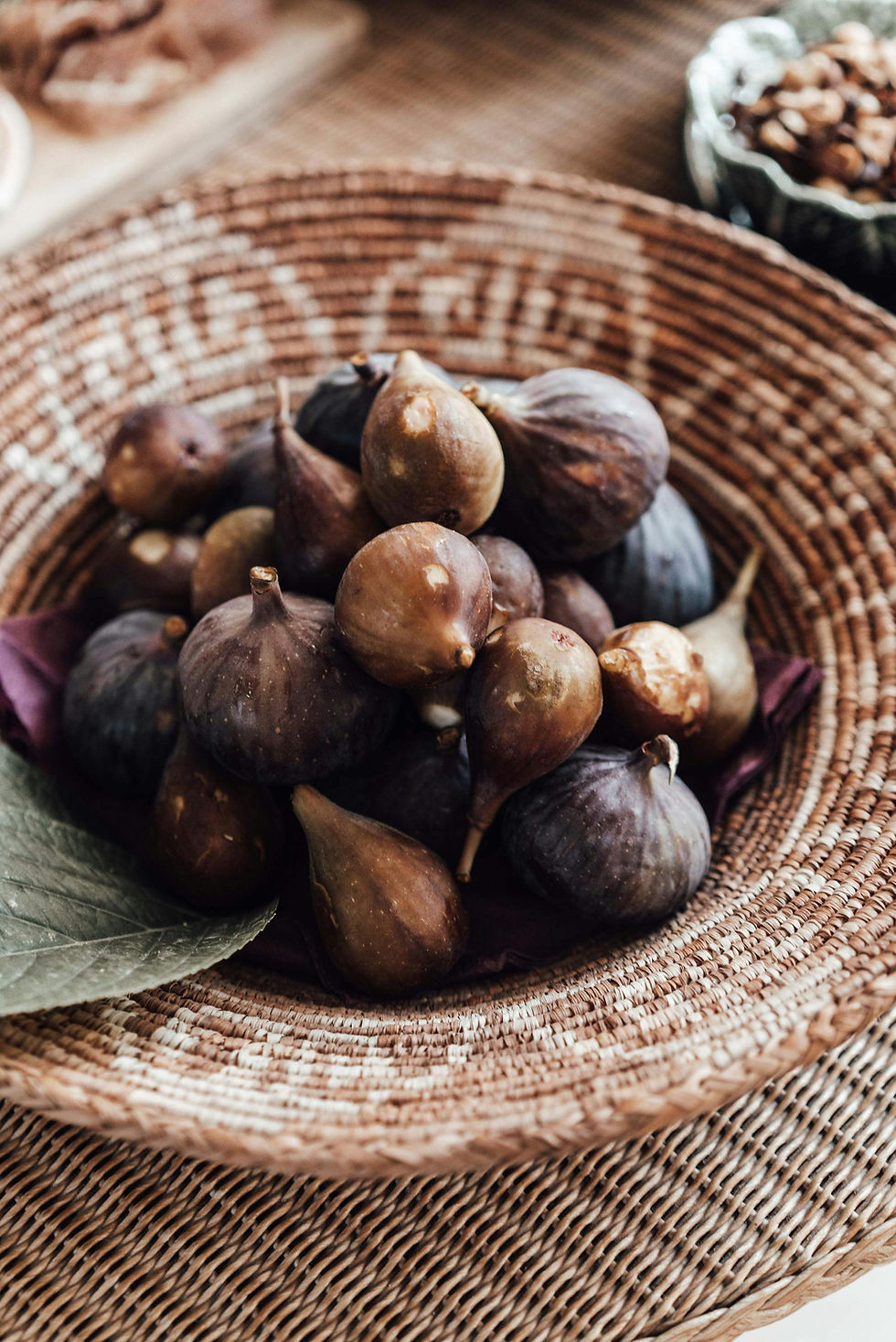
The image in this vision is a basket of summer fruit, likely referring to late-season figs that ripen in the eighth month of the agricultural calendar. The Gezer Calendar, a 10th-century BC inscription outlining the agricultural seasons of ancient Israel, refers to this period as the “month of summer fruit.” These figs were considered a sign that the harvest season was coming to an end. The significance of the vision lies not only in the fruit itself but in a wordplay between qayits (קַיִץ, “summer fruit”) and qets (קֵץ, “end”). By asking Amos what he sees, the Lord leads him to speak a word whose sound becomes the key to the vision’s meaning. It is a kind of prophetic pun—God uses Amos’s own response to declare that “the time is ripe” for judgment.
The final lines of the vision strike a dissonant note: “So many dead bodies!” “They are thrown everywhere!” “Silence!” While most of the vision is delivered in poetic form, these concluding cries break into raw, jarring prose. The structured rhythm of prophecy gives way to blunt, arresting language—perhaps intentionally disrupting the cadence to confront the reader with the shocking reality of death, silence, and loss.
Explanation
¶1: Summer fruit (8:1–3)
The Vision: Fruit That Signals the End
After the brief narrative interruption in 7:10–17, Amos now returns to his account of the visions God gave him. This fourth vision shares elements with all three of the previous ones: it begins with God showing something to Amos, includes the familiar phrasing “This is what the Lord God showed me,” and leads into a dialogue between the prophet and the Lord. But it is especially connected to the third vision. The two visions function almost like a pair—this one serving as a kind of climactic corollary to the previous. As in that earlier vision, God asks Amos what he sees, references His people Israel, and declares that He will no longer “pass by” them. Yet here, the message is even more final. The measuring is over. Their time has run out.
Whereas the first vision referenced spring and the second pointed to early summer, this fourth vision is set in late summer. Amos sees a basket of ripe summer fruit—likely the figs harvested in August or September. Normally this would be a celebratory image, tied to the Feast of Ingathering (Exodus 23:16), when Israel would bring offerings of thanksgiving for God’s provision. But here the image is subverted. Through a prophetic wordplay—qayits (summer fruit) and qets (end)—God announces that Israel is ripe not for blessing, but for judgment.
In the earlier visions, Amos interceded and God relented—passing by His people in mercy. But now, the long season of patience has passed. The fruit is ripe. The harvest is due. The wordplay captures the tragic reversal: summer fruit has become a sign of their end. The plumb line of vision three—God’s measuring of His people—has yielded its result: they are found crooked, unjust, and unfit. So now, in vision four, God makes it clear that the conclusion has been reached. The time for weighing and warning has passed. Israel’s end is at hand.
The Outcome: Mourning, Death, and Silence
The temple and high places, already condemned in vision three, are now filled with the sound of wailing. These were the places where Israel loved to gather, sing, and sacrifice—yet God had declared that He hated their songs and festivals (5:21–23). Now their music has changed. Instead of empty worship, there is genuine lament. But it is too late. These sacred places offer no protection on the Day of the Lord.
This “day” has been foreshadowed throughout Amos. It will be a day when even the bravest warriors flee in shame and defeat (2:16), when the Lord punishes His people and tears down their altars (3:14), when they are led away into exile with hooks and ropes (4:2). It is the day of darkness and no escape (5:18–20), when disaster overtakes them at every turn and no one rises to help (6:3). The Day of the Lord is not a festival—it is a funeral. And it is coming soon. No wonder songs of wailing will rise up—what else can be sung when everything is lost?
Amos records the people’s terrified cries: “So many dead bodies!” “They are thrown everywhere!” “Silence!” These final words come with chilling abruptness. Like the lament of 5:1–3, Israel is fallen, with no one to lift her up. Like the grim scene in 6:9–10, death piles upon death, and silence follows—not just out of fear, but out of despair. No one can argue with what has happened. No one dares speak in the presence of divine judgment.
And yet, there is an irony here. In chapter 7, the priest and people had tried to silence God’s word. There Amaziah and the leaders tried to silence God’s word and drive the prophet away. They did not want to listen. But now, they will not silence God—He will silence them and their excuses and appeals. He will no longer hear their songs—songs He had come to hate. Finally, He will have relief from the noise of their false worship. Only silence remains.
¶2: Wicked Israel punished (8:4–10)
Background Notes


The Law established holy days and festivals that were to be kept sacred—set apart for God. The most basic and regularly observed of these was the Sabbath, a weekly day of rest rooted in both creation and redemption. Israel was instructed to cease from labor every seventh day (Exod. 20:8–11; Lev. 23:3), not simply as a break from work but as a covenantal sign—a reminder that their lives, their land, and their labor ultimately belonged to the Lord. Unlike Pharaoh, who subjected Israel to unrelenting toil, the God of Israel gave His people rest. The Sabbath served as a weekly protest against self-reliance, pointing instead to God's faithful provision. In addition to the Sabbath, Israel was also called to observe new moon festivals, which marked the beginning of each month. These occasions were celebrated with trumpet blasts and sacrificial offerings (Num. 10:10; 28:11–15), and like the Sabbath, they were considered sacred assemblies in which all regular labor—including buying and selling—was to cease.
The ephah and shekel were common instruments of trade in ancient Israel, both part of a broader system of weights and measures shaped by Babylonian influence. The ephah was a dry measure used to sell and store grain, flour, and other staples. It held roughly 22 liters and was the largest standard dry unit in regular use. One ephah equaled 3 seahs or 72 logs, with the log being the base unit of volume—about 0.3 liters, equivalent to the volume of six eggs. The shekel, by contrast, was a unit of weight, typically used to measure silver or gold. One shekel weighed approximately 11.3 grams and was subdivided into 20 gerahs, the smallest unit in the biblical weight system. Merchants could manipulate these standards to exploit buyers: a smaller-than-standard ephah meant customers received less than they paid for, while a heavier-than-standard shekel unjustly inflated prices. Combined with rigged balances—such as altered crossbars or offset fulcrums—these practices enabled merchants to maximize profit through deliberate deception, especially against the poor and vulnerable. Such actions were explicitly forbidden in the Torah and described as an abomination (Deut. 25:13–16; Prov. 11:1).
The term “chaff of wheat” likely refers to the refuse swept from the threshing floor—the husks, straw, dirt, and debris that fell to the ground during grain processing. The Hebrew phrase literally means the “fallings” or “sweepings.” This material was typically discarded or fed to animals, never sold to people. By mixing this waste into ephahs for sale, merchants could increase volume without value, deceiving buyers by selling what was essentially inedible filler.
The reference to the Nile River rising evokes Egypt’s annual flood cycle, when the river overflowed its banks—usually in late summer or early autumn—to renew the land with fertile silt. While this was normally a source of life and blessing, it remained a powerful and uncontrollable force. In prophetic literature, the Nile could also symbolize Egypt itself—a proud, self-reliant empire and archetypal enemy of God’s people. Zechariah refers to it as the “sea of trouble” (Zech. 10:11), and in Ezekiel, Pharaoh boasts, “The Nile is mine; I made it” (Ezek. 29:3), drawing divine judgment. The imagery here may therefore convey both natural chaos and the collapse of political powers.
The phrase “darken the earth in broad daylight” may refer to a solar eclipse, an event widely viewed in the ancient Near East as a sign of divine displeasure. In Babylon, priests would tear their garments and chant laments during eclipses, interpreting them as omens of coming disaster. Whether literal or symbolic, the image underscores the suddenness and totality of the coming judgment.
The description of mourning draws on familiar cultural practices: tearing garments, placing dust on the head, cutting off the hair, and wearing sackcloth—a coarse cloth made from goat or camel hair, often worn around the waist in times of grief or repentance. To lose one’s only son was considered one of the deepest imaginable sorrows, marking the end of the family line and the loss of future hope. Amos uses this image to portray the bitter, irreversible devastation that will fall on the people when God’s judgment comes.
Explanation
¶2: Wicked Israel punished (8:4–10)
Israel’s Injustice and False Worship
Just as the third vision ended with an explanation and illustration of why God’s judgment was coming—in narrative form—followed by a declaration of finality, so too the fourth vision is immediately followed by a prophetic oracle that reaffirms the justice of God’s verdict. What Amos does here is not introduce new accusations, but summarize the charges he has already laid out, especially those from chapter 2. Like a skilled weaver, Amos threads together the major themes of the book—oppression of the poor, false worship, pride, and covenant violation—into a cohesive indictment. The result is clear: God’s decision to bring Israel to an end (8:2–3) is completely justified.
Once again, the poor are at the center of the charge. Rather than protecting and upholding the needy, as commanded in the covenant (cf. Deut. 15:7–11; 24:14–22), Israel’s elites trample them underfoot. They exploit them through corrupt systems of taxation, legal bribery, and social exclusion, all while growing ever more comfortable in their luxury and ease. But here, Amos adds a further dimension to the injustice: manipulation in the marketplace.
Merchants use shrinking ephahs—so that buyers receive less grain—and enlarged shekels, forcing them to pay more. To maximize profit further, they even sell sweepings of wheat—inedible debris usually discarded or fed to animals—and manipulate scales and balances in their favor. These corrupt practices make it impossible for the poor to survive on their wages. As a result, they are driven to sell themselves or their children into slavery just to stay alive.
This connects back to Amos 2:6, where the poor are sold for silver and a pair of sandals. Here, the reversal is complete—they are not only sold, but bought for the same paltry amounts. This forms a kind of inclusio, bracketing the entire book’s message: the poor have been completely commodified from beginning to end—treated as objects, dehumanized, and traded like livestock.
Sadly, this indictment repeats what has been said before. Yet what is most shocking in this passage is the timing of their schemes—plotted during days meant for worship. These merchants are not merely cheating people; they are conspiring during sacred festivals. On the very days that should celebrate God’s mercy and covenant faithfulness—Sabbath and new moon festivals—they are dreaming up new ways to exploit others. While appearing outwardly pious, they inwardly rebel. The day that marks Israel’s freedom from slavery becomes, in their hearts, a day for plotting the enslavement of others. For them, this gift of God—a day of rest and holiness—cannot end soon enough.
This hypocrisy echoes Amos 4:4, where the prophet sarcastically invites Israel to “Come to Bethel, and transgress.” Mays summarizes the tragedy well: “They love the Lord less, mammon more, and their fellows not at all.”
Israel assumes that God does not notice their hidden motives. But the God who is to be honored on these sacred days is the same one who sees the secrets of their hearts. The one to be worshiped as creator and sustainer will indeed bring justice to the land. And He swears an oath—His third in the book—that He will never forget what they have done. Curiously, the oath is sworn “by the pride of Jacob” (v.7). Oaths were normally sworn on something eternal or unshakable—such as the name of God (6:8) or His holiness (4:2). Here, “the pride of Jacob” may be a sarcastic reference to Israel’s arrogant confidence—their belief that they are untouchable because of their wealth and status, a pride that has led them into unrepentant wickedness and hardened their hearts against God's warnings. The very pride that God hates (6:8) is ironically used as the basis for His oath—because it, too, seems enduring and unshakable among them. Alternatively, it could point to what they ought to take pride in—God Himself—and so the oath, whether sarcastic or sincere, still reflects the seriousness of divine judgment.
God’s Judgment: Creation Unravels and Mourning Comes
Because God will not forget, creation itself trembles. Two images follow, likely referencing cataclysmic natural events. First, the land rises and falls like the Nile. Just as the Nile floods and recedes each year, so the land will heave and quake— possibly pointing to a great earthquake, perhaps even recalling the one mentioned in 1:1, as though the land itself begins to tremble under the weight of Israel’s guilt. Second, the sun is darkened at noon—likely a reference to a solar eclipse, a terrifying and widely recognized omen of divine wrath in the ancient world.
But these signs are more than just natural phenomena—they carry theological weight. The God who made the mountains and the daylight is now undoing creation. Israel, who has brought corruption into the land, will experience a kind of de-creation: the stable land becomes chaotic water, and light gives way to darkness. As in Genesis 1, before God’s ordering work, the world unravels into formlessness and void. The day of the Lord is coming, but it is a day of woe, not salvation.
Fittingly, these signs are framed by mourning. The land mourns (v.8), and the people’s festivals turn into lamentation (v.10). The joy of sacred days is reversed—scheming turns to sackcloth, and laughter to weeping. Just as they turned justice and righteousness into bitter poison, so God will turn their celebrations into bitter mourning. Amos compares their grief to that of a parent losing an only son—a sorrow that marks the end of the family line. For Israel, it marks the end of the nation itself.
The language of Nile, darkness, and the death of a son echoes the plagues of Egypt. The irony is sharp: Israel, once rescued from Egypt, now acts like Egypt—oppressing the weak—and so will be treated like Egypt. Those who ignored the meaning of the Sabbath, who forgot their own redemption and chose to become like Pharaoh, will now face the wrath they were once spared from.
The passage is structured around two human questions and two divine declarations. First, the people ask, “When will the new moon be over?”—not to worship, but to resume their greed. God responds with an oath: “I will never forget.” Then Amos asks, “Will not the land tremble?”—and God answers with a solemn promise of total mourning. What was hinted at in the vision of summer fruit (8:1–3) is now spelled out in full. The day of the Lord will not be rescue but reckoning, and the songs of the land will be replaced with wailing and grief.
¶3: Famine of the Word (8:11–14)
Background Notes


The phrase “from sea to sea” is a merism, a literary device that uses two extremes to represent a whole. In biblical usage, it often refers to the span from east to west—from the Dead Sea in the east to the Mediterranean Sea in the west (cf. Psalm 72:8; Zech. 9:10). It evokes the full stretch of the land, from the rising of the sun to its setting, and expresses totality.
Verse 14 describes three oaths made by Israelites, each exposing their misplaced spiritual loyalty. In the ancient world, to swear by a deity was to express allegiance and dependence on that god. Israel, however, was commanded to swear only by the name of Yahweh (Deut. 6:13; 10:20) and strictly warned never to swear by the names of foreign gods (Josh. 23:7). The first oath invokes “the guilt of Samaria,” likely referring to the false worship practiced in the Northern Kingdom. This may point to the worship of Asherah, a Canaanite fertility goddess commonly honored in Israel (2 Chron. 24:18), or possibly Ashimah, a foreign deity brought into Samaria after the Assyrian conquest (2 Kings 17:30). More broadly, it likely summarizes the idolatrous and syncretistic religion centered in Samaria, which replaced covenant faithfulness with foreign rituals. The second oath—“As your god lives, O Dan”—recalls the shrine Jeroboam I established in Dan, where he placed a golden calf as a substitute for the ark of the covenant (1 Kings 12:28–30). Though it claimed to represent the God of Israel, it distorted true worship and violated the covenant. The final reference to “the way of Beersheba” points to Israel’s religious practices in the far south, as it was a well-known pilgrimage site (Amos 5:5; 8:14). Alongside Dan in the north, it forms a poetic expression of the nationwide spiritual failure—from north to south, Israel’s worship was corrupted.
Explanation
¶3: Famine of the Word (8:11–14)
In the previous verses, God swore that because of Israel’s persistent sin and injustice, even creation itself would rise up against them, and the land would be filled with mourning. We might naturally assume that this is as bad as judgment can get. But in fact, God now reserves the most devastating judgment for the end. Just as their relationship with creation is shattered, so now their relationship with the Creator comes to a terrifying halt. The Lord will no longer speak. He will cease to commune with them. This is the true end to which the vision of the summer fruit pointed—the moment of irreversible rot, the reason for the wailing in the temple (vv. 1–3).
God warns that a day is coming when there will be a famine and drought in the land—not one of food or water, but of hearing the words of the Lord. This famine is different from those described in Amos 4:6–8, where God withheld rain or food to provoke repentance. Then, He acted in the physical realm to urge His people to return to Him. But here, the judgment is more final. This time, even if they want to repent, they will not be able to find Him. Just as they once wandered from city to city for water, so now they will wander across the whole land—from sea to sea, from north to east—desperate to hear His voice, but in vain.
Earlier in the book, Amos called the people to “seek the Lord and live” (5:4–5). Life is found only in relationship with God and through His living word. But in this day of famine, even if they seek, He will not be found. And where His word is absent, life withers. The people will move from wandering to frantically running, from running to staggering in weariness, and finally to falling—never to rise again.
Amos highlights the young men and virgins—symbols of Israel’s strength, vitality, and future. If even they collapse in this judgment, what hope can anyone else have? But these figures also echo themes already introduced. In 2:11, God had raised up young men to serve as prophets, calling Israel back to Him—but the people silenced them. Now those same youth will be aimless wanderers, unable to point to any truth. In 5:2, the “virgin Israel” had fallen, forsaken in the streets with no one to raise her. That image now reaches its fulfillment: she is not just fallen but abandoned by God, without His word to sustain her or His protection to shield her. The result is judgment and death.
In their despair, they begin to seek help elsewhere. With no word from the true God, they turn to other gods. They swear oaths of loyalty to the idols of their land. They look to the religious centers they have built—from Samaria, to Dan in the north, to Beersheba in the south—but they find only imitation. Golden calves stand in place of God, false altars offer no mercy, and the rituals are empty. They wander on pilgrimages to sacred places and yet are not satisfied. They have been forsaken by the Author of Life, and now life cannot be found.
The theme of silence has now come full circle. Israel has long refused to listen to God and even tried to silence His prophets (2:11; 7:12–13). They hardened their hearts and closed their ears. Now, at last, God gives them what they wanted—but it is not what they truly needed. In the end, they are silenced by judgment (6:10; 8:3), but the deeper and more terrifying silence is this: the silence of God Himself. It is not just the noise of festivals or the voices in the streets that cease. It is the voice of the Lord that is no longer heard. And in that silence, Israel is undone.
Summary & Application

Amos 8:1–14
Fourth Vision
This section describes the fourth of five visions given to Amos and reported to Israel. It opens with a striking image and then unfolds its meaning in full. As the passage progresses, the message becomes darker and more devastating—moving from mourning, to silence, to the loss of God Himself.
Israel has trampled the poor, treating them as commodities to be bought and sold. In their marketplaces, they use deceitful scales, manipulate prices, and sell even the sweepings of grain as if it were food. What makes their injustice most damning, however, is its occasion: they scheme these things during holy days—on Sabbaths and new moons—when they should be remembering God’s redemption from Egypt and their covenant with Him. Outwardly religious, they inwardly long to return to greed. Instead of remembering mercy, they become like Egypt—unjust and unrepentant—and violate the very covenant they were called to honor.
For this reason, the Lord swears that He will not forget. The land itself will rise up in judgment—shaking with earthquakes and darkening at noon. Creation, once a place of provision, will become a place of chaos and death. Their festivals will turn into funerals, their joy into grief, their hope into despair. Instead of songs, there will be wailing. Instead of celebration, sackcloth and sorrow. The rhythms of worship will become laments as God undoes His gifts and creation itself begins to unravel.
Yet the most terrifying judgment comes last. Not only will their relationship with the land be broken, but their communion with God will end. He promises a famine—not of bread or water, but of hearing the words of the Lord. He will no longer speak. He will no longer be found. In the past, when God sent physical famines, it was to draw His people back to Him. But now, even if they seek Him, they will not find Him. It will be too late. They will wander across the land—from sea to sea, from north to east—desperate to hear a word from God, but the silence will be complete. The prophets have been silenced. The covenant ignored. And now God gives them what they have long chosen: distance from Him.
In their desperation, they will turn to other gods. They will swear loyalty to idols in Samaria, Dan, and Beersheba. But these are not God—and they cannot save. They may even become agents of their destruction. Israel, once called a virgin with promise and hope, will fall and never rise again. She will die in judgment, abandoned by the God she rejected. The Day of the Lord has come—and it is not rescue but reckoning.
All of this is framed by the opening vision of summer fruit. What should have signaled harvest and joy becomes a sign that Israel is ripe for judgment. Through the wordplay between summer fruit and end, God declares that their season has run out. They tried to silence His word, but now He will silence them—and more terrifying still, He will be silent Himself.
Ideas About Discipleship and Service
Once again, Amos calls God’s people to live with justice and righteousness. This means caring for the poor and vulnerable, but also living with integrity and fairness in daily life. God desires truth not only in worship but in our work, our business dealings, and how we treat others behind closed doors.
Where in your life might God be calling you to greater honesty or compassion?
How can you reflect His justice in the ordinary rhythms of work or leadership?
This passage warns of the danger of hardening our hearts. God is always willing to forgive, but persistent sin makes us deaf to His voice. Over time, we may stop wanting His Word at all. And if we continually silence Him, He may allow us to have what we’ve asked for—distance and silence.
Are there any areas where you’ve grown dull to God’s voice or resistant to His correction?
How might you soften your heart and listen again?
Israel kept observing their religious feasts, yet their worship was empty. We too can go through the motions—attending church, reading Scripture, saying the right words—yet with hearts far from God. But He is not seeking rituals. He is seeking relationship.
Are your spiritual practices helping you encounter God—or just filling a routine?
How can you create space to truly meet with Him?
While Israel faced a famine of God’s word as judgment, we often choose one ourselves—by the way we live. We fill our minds with entertainment and news but make no room for Scripture or prayer. We do not seek God’s voice, and so we don’t hear it.
What voices fill your attention and shape your thinking?
How could you re-center your life to listen to God’s word?
As followers of Jesus, we know that He is the Word made flesh, the bread of life who alone can satisfy our hunger. Through Him, God has spoken fully and finally. In every season, we are invited to seek Him, listen to Him, and be nourished by Him through His Word and by His Spirit.
What would it look like this week to seek Jesus as your daily bread?
How might you allow His Word to feed and shape your soul?
Other resources
© 2025 Practical Bible. All rights reserved.